
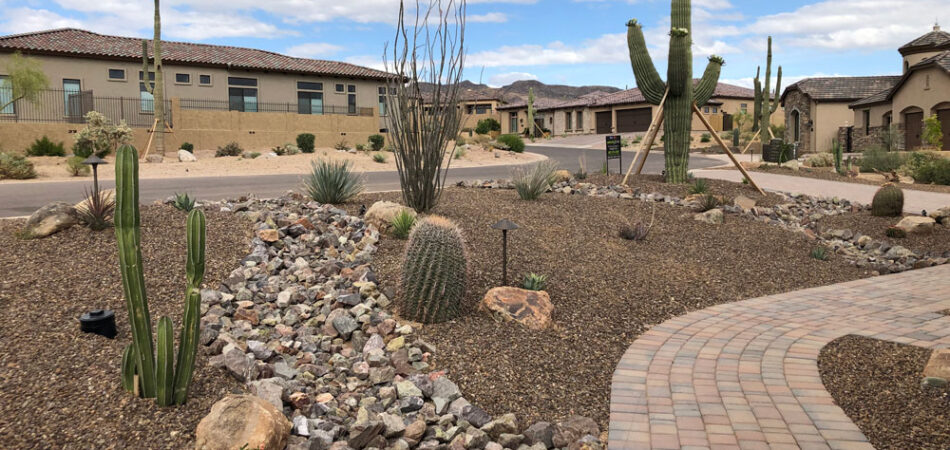
Moving into a newly built home in Phoenix can feel exciting right up until you look through the back door and see a rectangle of bare dirt. In the Valley, that unfinished yard is more than a cosmetic project. Desert heat, intense sun, monsoon runoff, water use, and plant selection all affect what will work long term.
Quick answer: If your new backyard is dirt, start by planning how you want to use the space before installing plants, turf, irrigation, or hardscape. In Phoenix, a successful backyard plan should account for drainage, irrigation, shade, desert-adapted plants, sun exposure, and the realities of maintaining landscaping through extreme summer temperatures. Getting the layout right first can help prevent expensive changes later.
What local homeowners should know
-
Plan the entire backyard before installing individual features so irrigation, drainage, plants, hardscape, and gathering areas work together.
-
Phoenix properties need landscaping choices that account for intense summer heat and prolonged direct sunlight.
-
Monsoon storms can expose drainage problems that are difficult to notice while a backyard is still unfinished.
-
Desert-adapted landscaping can create an attractive yard without treating a Phoenix property like one in a wetter climate.
-
Think about future needs, including shade, pets, children, entertaining, storage, and maintenance, before committing to the layout.
Why Does Landscaping a New Backyard Matter in Phoenix?
Landscaping a new backyard matters in Phoenix because the desert environment affects nearly every decision, from where plants go to how irrigation and drainage should be designed. A yard that looks good on installation day also needs to function through extreme heat, dry conditions, intense sunlight, dust, and seasonal monsoon storms.
The Valley of the Sun creates challenges that homeowners in milder climates simply do not face. A plant placed beside a west-facing wall, for example, may experience both afternoon sun and reflected heat. An outdoor seating area without a shade strategy can become difficult to use during much of the year.
Conditions can also vary across the metro area. Properties near North Phoenix, Ahwatukee, Arcadia, and neighboring communities such as Scottsdale and Tempe may have different lot layouts, exposures, and existing neighborhood landscaping.
Landscape 20/20 LLC helps homeowners think through these practical considerations when turning unfinished outdoor areas into usable landscapes. From here, we will refer to our team as we, our, and us.
What Do Local Conditions Tell Us About Backyard Planning?
Local conditions show that Phoenix backyard planning should prioritize heat, water management, shade, and plant suitability from the beginning. The National Weather Service recognizes extreme heat and monsoon thunderstorms as significant parts of Arizona’s weather environment, making climate-responsive landscape planning especially relevant for Valley homeowners.
For a new homeowner, those conditions affect practical decisions. Shade can influence where people actually spend time outdoors. Irrigation zones can help plants with different watering needs receive appropriate care. Drainage planning can influence where stormwater moves when heavy rain arrives.
Rather than copying a landscape designed for another climate, build around the Sonoran Desert environment you actually live in.
How Can a Dirt Backyard Affect Your New Home?
A bare dirt backyard can affect outdoor comfort, usability, dust, drainage, and how easily you can establish a finished landscape later. The longer-term issue is not simply that dirt looks unfinished. It is that every improvement you make without an overall plan can constrain the improvements that follow.
Imagine installing artificial turf first and deciding six months later that you want a shade structure, expanded patio, or different irrigation layout. Parts of the completed landscape may need to be disturbed.
Planning first gives you a chance to organize the yard around how you expect to live in it.
What Signs Show Your Backyard Needs More Planning?
Your backyard needs additional planning when basic questions about drainage, irrigation, shade, access, or long-term use still do not have clear answers. Before investing heavily in materials or plants, Phoenix homeowners should look for signs that the property’s overall landscape plan needs attention.
Common warning signs include:
-
Water appears to collect near the house or in low sections after rain.
-
You do not know where irrigation lines should run.
-
Most of the backyard receives intense afternoon sun.
-
You have selected plants without considering mature size or sun exposure.
-
Hardscape locations interfere with natural movement through the yard.
-
You plan to add features later but have not reserved space for them.
-
Different parts of the yard have noticeably different drainage or exposure conditions.
When Should You Call a Landscaping Professional?
Call a landscaping professional when the project involves multiple interconnected decisions, such as grading, drainage, irrigation, hardscape, planting, or an overall backyard transformation. Homeowners can safely handle tasks such as gathering inspiration, identifying priorities, and monitoring sun patterns, but technical installation decisions deserve more careful planning.
Phoenix yards can be unforgiving of trial and error. Moving a chair is easy. Relocating installed hardscape or correcting an irrigation layout is considerably more involved.
A professional can also help turn a list of ideas into a cohesive plan rather than a collection of unrelated backyard features.
What Common Phoenix Conditions Shape Landscape Design?
The most common Phoenix conditions shaping landscape design are extreme heat, intense sunlight, limited rainfall, monsoon storms, and the need for thoughtful irrigation. These factors should influence the layout before homeowners focus on colors, decorative rock, or individual plants.
1. Heat and sun exposure. South- and west-facing areas can experience substantial heat, especially near walls and hard surfaces.
2. Water needs. Irrigation should reflect the plants and landscape zones it serves rather than watering every area identically.
3. Monsoon runoff. Heavy seasonal storms can reveal low spots and drainage paths quickly.
4. Desert conditions. Plant choices should be appropriate for the local environment and the specific exposure within the yard.
5. Outdoor comfort. Shade becomes part of functional design when creating patios, seating areas, and places where children or pets may spend time.
How Should You Maintain a New Phoenix Landscape?
Maintain a new Phoenix landscape by checking irrigation, watching plant establishment, monitoring drainage, and adjusting care as seasonal temperatures change. New landscaping needs observation, especially as homeowners experience their first full summer and monsoon season with the finished yard.
Check irrigation for leaks, clogged emitters, and areas receiving inappropriate amounts of water. Watch plants for signs that their location or watering needs may not be working. After significant rain, observe where water travels rather than assuming drainage is performing correctly.
DIY monitoring is useful. Repairs involving irrigation systems, grading, or significant landscape changes may be better handled professionally.
What Results Should You Expect From a Finished Backyard?
A well-planned finished backyard should give your household a more functional, attractive, and manageable outdoor space rather than simply covering bare dirt. Results depend on the design, materials, plant choices, maintenance, and how closely the landscape fits your household’s actual needs.
For some Phoenix homeowners, success means a shaded entertaining space. For others, it means a low-maintenance desert landscape, room for pets, more greenery, or a combination of hardscape and planted areas.
There is no single correct desert backyard. The goal is a yard designed intentionally for your property and lifestyle.
What Landscaping Mistakes Should New Homeowners Avoid?
New homeowners should avoid installing landscaping in pieces without considering how each decision affects the rest of the backyard. In Phoenix, mistakes involving shade, irrigation, drainage, and plant placement can become particularly noticeable once summer temperatures or monsoon storms arrive.
Mistake: Choosing plants based only on appearance.
Consequence: A plant may be poorly matched to its exposure or available space.
Better approach: Consider sunlight, mature size, water needs, and placement first.
Mistake: Ignoring drainage.
Consequence: Rain may collect or travel where you did not expect it.
Better approach: Understand drainage before installing permanent features.
Mistake: Designing without shade.
Consequence: Attractive outdoor areas may be uncomfortable during hotter months.
Better approach: Include shade and sun exposure in the initial layout.
Mistake: Building one feature at a time.
Consequence: Future improvements may require removing completed work.
Better approach: Develop the overall plan first, even if you install it in phases.
What Does a Typical New-Construction Backyard Project Look Like?
A common local scenario starts with a Phoenix homeowner receiving a finished house and an unfinished dirt backyard, then trying to decide what should come first. This is a representative scenario, not a specific Landscape 20/20 LLC customer project.
The homeowner might want a patio extension, artificial turf or another ground treatment, desert plants, irrigation, and an area for entertaining. Installing those features independently could create conflicts.
A better sequence is to identify uses, evaluate the site, plan drainage and irrigation, establish hardscape locations, determine planting areas, and then develop an installation sequence. If budget requires phases, the master plan can still guide each phase.
Which Landscaping Services Can Turn Dirt Into a Finished Yard?
The right landscaping services turn a dirt backyard into a coordinated outdoor space by addressing the site as a complete system rather than a collection of separate installations. Depending on the property and desired design, that can involve landscape planning, irrigation, planting, ground treatments, hardscape, and related improvements.
Our role is to help homeowners evaluate which solutions make sense for their property instead of assuming every backyard needs the same features.
Should You DIY Your Backyard or Hire a Professional?
DIY landscaping can work for smaller cosmetic projects, while professional landscaping is generally more appropriate when your backyard requires coordinated grading, irrigation, hardscape, planting, or multiple installation phases. The best choice depends on project complexity, homeowner experience, available time, and the consequences of having to redo completed work.
DIY can make sense for movable décor, simple garden tasks, and ongoing maintenance. Professional help becomes more valuable as permanent systems begin overlapping.
A hybrid approach is another option. Homeowners can establish a professional plan and installation framework while handling appropriate maintenance or finishing touches themselves.
What Areas Can Landscape 20/20 LLC Serve?
Landscape 20/20 LLC can discuss landscaping needs in Phoenix, while homeowners in nearby communities should confirm whether their property falls within our current service area.
What Can Happen If You Leave a Dirt Backyard Unplanned?
Leaving a backyard unfinished is not necessarily an emergency, but delaying an overall plan can make later improvements less efficient if temporary decisions become obstacles to the final landscape. Phoenix homeowners may also continue dealing with an outdoor area that provides limited shade, greenery, gathering space, or other practical use.
The bigger risk is spending money in the wrong order. Planning the complete space before committing to permanent features can reduce the likelihood that completed work needs to be reconsidered later.
FAQ About Landscaping a New Backyard in Phoenix
What should I do first with a dirt backyard in Phoenix?
Start by deciding how you want to use the backyard and developing an overall layout before installing permanent features. Consider seating, pets, children, entertaining, shade, planting, irrigation, drainage, and maintenance. Phoenix heat and monsoon conditions make it especially useful to understand the entire site before choosing individual materials.
When is the best time to landscape a new backyard in Phoenix?
The best timing depends on what you are installing, especially because planting and outdoor work can be affected by extreme summer heat. Planning can begin at any time, but installation schedules and plant establishment should account for seasonal conditions. Discuss the proposed materials and plant selections before choosing a project timeline.
Do Phoenix backyards need irrigation?
Many planted Phoenix landscapes benefit from appropriately designed irrigation because natural rainfall is limited and inconsistent. The exact system depends on the landscape design and plants selected. Irrigation should be planned before permanent surfaces make routing or modifying lines more difficult.
Should I use desert plants in my Phoenix backyard?
Desert-adapted plants are often practical choices because they can fit the Sonoran Desert climate when matched correctly to the site. Plant selection should still consider sunlight, mature size, water requirements, nearby structures, and the design you want. “Desert plant” does not automatically mean that every location is suitable.
How should monsoon storms affect my landscape plan?
Monsoon storms make drainage an important part of landscape planning because short periods of heavy rain can reveal how water travels across your property. Before installing permanent backyard features, pay attention to low areas, runoff paths, and water movement around the home. Significant drainage concerns deserve professional evaluation.
Is artificial turf a good option for a Phoenix backyard?
Artificial turf can be one option for Phoenix homeowners, but it should be evaluated as part of the entire landscape rather than chosen automatically. Consider heat exposure, intended use, drainage, maintenance, surrounding materials, pets, and how much turf you actually need before deciding whether it fits your backyard.
How important is shade in an Arizona backyard?
Shade can significantly influence how usable an Arizona backyard feels during hot, sunny periods. Think about afternoon sun when locating patios, seating, play areas, and plants. Existing walls, orientation, vegetation, and future shade features can all influence where outdoor living spaces make the most sense.
Can I landscape my Phoenix backyard in phases?
Yes, a Phoenix backyard can be landscaped in phases if those phases follow an overall plan. Planning first helps ensure today’s installation does not occupy space needed for tomorrow’s irrigation, patio, planting, or other features. A phased strategy can also let homeowners prioritize the improvements that matter most to them.
Build a Phoenix Backyard Designed for Desert Living
A successful Phoenix backyard starts with a thoughtful plan for the property, the desert climate, and the way your household wants to use its outdoor space. We can help you explore landscaping options that turn an unfinished dirt yard into a more functional outdoor environment.
Turn Your Dirt Backyard Into an Outdoor Space You Can Enjoy
Start with a plan that accounts for Phoenix heat, water, drainage, and your long-term goals.