
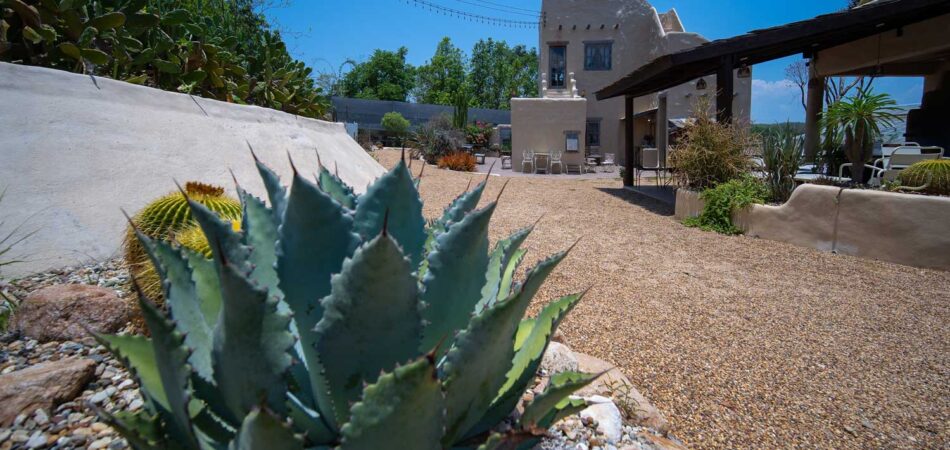
A Phoenix yard has to survive more than months of intense heat and dry weather. During monsoon season, the same landscape can suddenly face strong winds, blowing dust, fast-moving runoff, and concentrated rainfall.
Designing for those extremes from the beginning can help protect plants, hardscape, irrigation components, and the areas around your home.
Quick answer: A Phoenix landscape designed for monsoon weather should move and capture stormwater safely, use desert-adapted plants in appropriate locations, provide adequate drainage around structures, and account for wind exposure when placing and maintaining trees. Grading, swales, basins, erosion control, plant spacing, and irrigation design should work together rather than being treated as separate features.
What local homeowners should know
-
Arizona’s official monsoon season runs from June 15 through September 30, according to the University of Arizona Cooperative Extension.
-
Compacted soil and caliche can interfere with drainage and root development in desert landscapes.
-
Swales, basins, and other passive rainwater-harvesting features can slow runoff and allow more water to soak into appropriate landscape areas.
-
Trees and shrubs should be selected and positioned with mature size, roots, drainage, and wind exposure in mind.
-
Irrigation schedules may need adjustment after meaningful summer rainfall rather than continuing unchanged through monsoon season.
Why Does Monsoon-Ready Landscape Design Matter in Phoenix?
Monsoon-ready landscape design matters in Phoenix because Valley properties must function through long dry periods and sudden summer storms. A yard designed only around drought tolerance can still experience runoff, erosion, standing water, displaced rock, damaged plants, or problems with trees when intense weather arrives.
The University of Arizona Cooperative Extension notes that Arizona’s low deserts experience high evaporation and relatively limited annual precipitation. It also identifies rainwater harvesting as a way to supplement landscape irrigation while mitigating stormwater impacts.
That combination makes thoughtful water management particularly useful across Maricopa County.
At Landscape 20/20 LLC, we approach landscape planning with these local conditions in mind. Our goal is to create outdoor spaces that look intentional while accounting for how water, soil, plants, and hardscape interact on the property.
What Does Local Data Tell Us About Desert Landscape Drainage?
Local desert landscape guidance shows that managing limited but concentrated rainfall is an important part of landscape planning. University of Arizona Cooperative Extension guidance reports that the Phoenix area receives roughly 8 inches of average annual rainfall, while precipitation across the desert Southwest can vary considerably from year to year.
The same guidance explains that passive rainwater harvesting can use features such as basins and swales to retain runoff where it can benefit vegetation. Rock check dams can also slow water moving through a swale, encouraging infiltration instead of allowing runoff to rush immediately toward a low point.
This does not mean every yard should hold as much stormwater as possible. Water still needs an appropriate place to go without threatening foundations, patios, walls, walkways, or neighboring properties.
How Can Monsoon Storms Affect a Phoenix Yard?
Monsoon storms can expose drainage, erosion, planting, and tree-management problems that remain almost invisible during dry weather. Runoff may follow unintended paths, low areas can collect water, soil can wash away, and trees with structural weaknesses may be more vulnerable during strong winds.
Homeowners may notice gravel moving across walkways, soil washing out around plants, water concentrating near patios, or irrigation components becoming exposed.
Heavy rain also changes irrigation needs. University of Arizona Cooperative Extension recommends adjusting landscape irrigation according to local monsoon rainfall rather than automatically watering on the same summer schedule.
What Warning Signs Suggest Your Landscape Is Not Storm-Ready?
A landscape may not be storm-ready when water, soil, or vegetation repeatedly behaves in ways that could damage the property during heavy weather.
Watch for:
-
Water collecting next to the home’s foundation after rainfall.
-
Standing water that remains in planting areas because the soil drains poorly.
-
Gravel, mulch, or soil washing onto sidewalks, patios, or driveways.
-
Channels forming where stormwater repeatedly cuts through the landscape.
-
Exposed plant roots after heavy rainfall.
-
Trees with damaged, poorly structured, or excessively dense canopies.
-
Low areas that receive runoff from several hard surfaces at once.
-
Downspout or roof runoff discharging into an area with no clear drainage strategy.
One storm may reveal a problem. Repeated patterns usually provide better clues about how water naturally travels across the site.
When Should You Call a Landscape Professional?
You should consider professional landscape help when drainage, grading, erosion, tree placement, or stormwater movement affects structures or requires significant changes to the property. Simple observation is useful, but reshaping drainage patterns without understanding where the water will go can move a problem instead of solving it.
During a safe rainfall event, homeowners can observe where runoff enters the yard, where it accelerates, and where it collects. Taking photos or video from a protected location can help document those patterns.
Professional planning becomes especially useful when water repeatedly approaches the home, crosses hardscape, causes erosion, or collects in areas that do not drain properly.
What Causes Monsoon Problems in Phoenix Landscapes?
The most common monsoon problems are usually connected to drainage, soil conditions, water concentration, plant placement, and maintenance rather than rainfall alone.
1. Compacted Soil
Compacted urban soil limits water penetration and root growth. University of Arizona Cooperative Extension notes that compacted soils can reduce water infiltration and air exchange.
2. Caliche or Restrictive Soil Layers
Caliche and other relatively impervious layers can interfere with drainage. A planting area may appear suitable at the surface while water has difficulty moving deeper into the soil.
3. Concentrated Hardscape Runoff
Roofs, driveways, patios, and walkways do not absorb rainfall like planted soil. Water flowing from several hard surfaces into one small landscape area can create erosion or pooling.
4. Poorly Located Trees
A tree needs enough space for its mature canopy and root system. Location also matters when considering buildings, walls, streets, sidewalks, and areas that receive harvested stormwater.
5. Erosion-Prone Bare Areas
Fast-moving water can carry loose soil and landscape material downhill. Vegetation, appropriate grading, and properly designed erosion-control features can help slow that movement.
How Can You Prepare a Phoenix Landscape Before Monsoon Season?
Preparing a Phoenix landscape before monsoon season means checking drainage paths, irrigation, trees, loose materials, and erosion-prone areas before storms expose existing weaknesses.
Walk the property before summer storms become frequent. Look at downspouts, roof drainage areas, low spots, slopes, planting basins, gravel borders, and places where water has previously left sediment behind.
Review tree condition as well. University of Arizona Cooperative Extension notes that monsoon storms can produce strong, damaging winds and that very heavy tree canopies can be more susceptible to wind injury. Tree work should be appropriate for the species and condition rather than simply removing large amounts of foliage.
After significant rainfall, check irrigation schedules and soil moisture before automatically adding more water.
What Results Can You Expect From Better Storm-Ready Landscape Design?
Better storm-ready design can give rainfall a more intentional path through the property while supporting healthy plants and reducing avoidable erosion. The exact solution depends on the site’s elevation, soil, hardscape, existing vegetation, and where water enters and exits the property.
A successful design may slow runoff, distribute captured rainfall across useful planting areas, stabilize vulnerable soil, and keep inappropriate standing water away from structures.
The objective is not to eliminate every effect of severe weather. It is to design the landscape so ordinary desert storm conditions are considered before the next storm arrives.
What Mistakes Should Phoenix Homeowners Avoid?
Several common landscape mistakes can make monsoon-related problems harder to manage.
Mistake: Creating a basin directly against a structure.
Consequence: Captured water may collect where it is not wanted.
Better approach: Direct harvested water toward appropriate landscape areas while protecting structures.
Mistake: Assuming decorative rock solves drainage.
Consequence: Water can still flow underneath or carry smaller material away.
Better approach: Address grading and water movement first, then use surface materials appropriately.
Mistake: Planting without considering mature size.
Consequence: Trees and shrubs may eventually conflict with walkways, walls, streets, or other landscape elements.
Better approach: Design around mature plant dimensions and root-zone needs.
Mistake: Leaving irrigation unchanged after substantial rain.
Consequence: Plants may receive unnecessary additional water.
Better approach: Monitor rainfall and soil conditions and adjust irrigation appropriately.
What Is a Common Monsoon Drainage Scenario in Phoenix?
A common Phoenix scenario is a front or backyard that appears completely functional during dry months but reveals a concentrated runoff path during the first strong summer storm.
Water may come from the roof, driveway, or an elevated portion of the property and rush toward one low planting bed. Gravel shifts, soil erodes, and water collects around plants that were never selected for prolonged saturation.
Instead of repeatedly replacing gravel, a more durable approach is to examine the entire drainage path. Grading adjustments, a properly located swale or basin, erosion-resistant planting, or other site-specific improvements may address the underlying water movement.
Which Landscape Services Can Help With Monsoon Preparation?
Landscape design and installation services can help address monsoon preparation by coordinating grading, planting, irrigation, hardscape, and stormwater considerations as parts of one outdoor system.
Depending on the property, useful solutions may include landscape redesign, planting improvements, drainage-oriented grading, passive rainwater-harvesting features, irrigation adjustments, and erosion-control improvements.
Should You DIY Monsoon Preparation or Hire a Professional?
DIY monsoon preparation works best for observation and basic maintenance, while professional help is more appropriate when changing grading, drainage paths, major plant placement, or other interconnected landscape features.
Homeowners can safely inspect for erosion, photograph runoff patterns, clear obvious landscape debris, monitor irrigation, and identify recurring trouble spots.
More substantial changes require a broader view. Redirecting water away from one problem area can send it somewhere worse, so drainage modifications should account for the entire site.
What Areas Can Benefit From Monsoon-Ready Landscaping?
Monsoon-ready landscape planning can benefit properties throughout Phoenix and surrounding Maricopa County communities because intense summer storms are a regional concern. Homeowners in areas such as Arcadia, Ahwatukee, North Phoenix, and neighborhoods near the Phoenix Mountains may encounter very different lot configurations, slopes, soils, and runoff patterns.
The same design principles can also be relevant in nearby Valley communities such as Scottsdale, Tempe, Glendale, and Paradise Valley, depending on the individual property.
What Can Happen If Landscape Drainage Problems Are Ignored?
Ignoring landscape drainage problems can allow recurring erosion, displaced materials, standing water, and plant stress to continue each time significant rainfall follows the same path. Small channels can become more pronounced, and repeated runoff may keep washing soil or decorative material from vulnerable areas.
Problems close to structures deserve particular attention. Waiting until the next major storm provides another test, but it can also mean another round of cleanup.
Frequently Asked Questions
When is monsoon season in Phoenix?
Arizona’s official monsoon season runs from June 15 through September 30. The timing and intensity of rainfall vary, so Phoenix homeowners should prepare landscapes before storms begin rather than relying on a particular date for the first significant rain.
Are swales useful in Phoenix landscaping?
Yes, properly designed swales can help slow and direct runoff while encouraging water infiltration in suitable landscape areas. University of Arizona Cooperative Extension guidance discusses swales as part of passive rainwater harvesting. Their placement and dimensions should reflect the property’s grading, soil, plants, and drainage needs.
Why does water stand in some Phoenix yards after heavy rain?
Standing water can result from low areas, compacted soil, clay-rich conditions, restrictive layers such as caliche, or concentrated runoff entering faster than the soil can absorb it. Determining the cause is important because simply filling a low spot may redirect water somewhere else.
Should I turn off irrigation after a Phoenix monsoon storm?
Irrigation may need to be reduced or temporarily skipped when rainfall has supplied enough moisture for the landscape. University of Arizona Cooperative Extension recommends adjusting irrigation based on local monsoon conditions. Check soil moisture and plant needs rather than assuming every rainfall event provides the same amount of usable water.
Can desert plants handle heavy monsoon rain?
Many desert-adapted plants tolerate seasonal rainfall, but drainage and placement still matter. Even drought-tolerant plants can struggle where water remains around roots for too long. Matching each species to the site’s soil, exposure, drainage, mature size, and irrigation zone helps create a more resilient landscape.
Does caliche affect landscape drainage in Maricopa County?
Caliche can restrict water movement and root development when a hard layer occurs beneath a landscape. University of Arizona Cooperative Extension identifies caliche as one condition that can contribute to poor drainage. Site conditions vary, so persistent drainage problems should be evaluated rather than assuming caliche is always the cause.
Should trees be heavily thinned before Phoenix monsoon season?
Not automatically. Tree pruning should consider the species, structure, condition, and appropriate pruning practices. Removing excessive live canopy can create other problems. If a tree has questionable structure, damaged limbs, or significant wind exposure, professional evaluation is safer than aggressive pruning solely because monsoon season is approaching.
Can rainwater harvesting work in a Phoenix residential landscape?
Yes. Passive rainwater harvesting can use grading, basins, swales, and related landscape features to direct rainfall toward suitable planted areas. University of Arizona Cooperative Extension identifies rainwater harvesting as both a landscape water-conservation strategy and a way to help mitigate stormwater impacts in Arizona’s low desert.
Build a Landscape That Is Ready for the Valley’s Extreme Weather
A resilient Phoenix landscape should work through dry heat and summer storms, not just look good between them. Thoughtful drainage, appropriate plant selection, erosion control, irrigation planning, and careful placement of landscape features can help create an outdoor space better suited to Sonoran Desert conditions.
Prepare Your Phoenix Property Before the Next Monsoon
We can help you explore landscape solutions designed around your property’s drainage, plants, outdoor spaces, and local desert conditions.